Food regulation decides which health claims a producer may make, and nutrition labels disclose isolated facts. Both functions are built with care, and across jurisdictions they converge on the same design: permission and factual disclosure are structured, while usable understanding is left to the reader. This paper traces that pattern through five regulatory regimes and finds it consistent across different regulatory designs. The comprehension evidence confirms the consequence — health claims can shift perception and purchasing while producing uneven understanding, while fuller nutrition information is often only selectively attended. This is not a weakness in claims regulation; it is the edge of what a permission instrument is built to do. The paper proposes no model. It sets out the boundaries any response would need to respect: that it could not be another claim, advice, or a seal of approval, and could not let contextual information drift into marketing.
Thesis
A lawful claim and a full nutrition panel can still leave product context for the reader to assemble.
Position in the series
This paper examines health claims regulation and the gap between permission and reader comprehension. Across the SGPIS series, the same structural pattern appears from different institutional angles: nutrition labels (SGPIS-NL-01), certification (SGPIS-GQ-01), traceability (SGPIS-GQ-02), geographic indication (SGPIS-PI-01), trade documentation (SGPIS-TC-01), and India’s product-information stack (SGPIS-SY-01) each perform defined functions, but none consistently carries enough information for the product to remain understood across settings.
Citation
APA
Ahmed, S. (2026). Health Claims vs. Health Information. Structural Gaps in Product Information Systems, SGPIS-NL-02. Altibbé Research. https://doi.org/10.5281/zenodo.20540474
Institutional
Ahmed, S. (2026). Health Claims vs. Health Information. Structural Gaps in Product Information Systems, SGPIS-NL-02, v1. Altibbé Research. https://doi.org/10.5281/zenodo.20540474
Structural Gaps in Product Information Systems — Nutrition Labelling subseries
Paper SGPIS-NL-02
Why a lawful claim and a full nutrition panel can still leave product context for the reader to assemble
Shams Ahmed · Altibbe Inc. · California · June 2026Licence: CC BY-NC-SA 4.0
Executive summary
Food regulation decides which health claims a producer may make, and nutrition labels disclose isolated facts. Both functions are built with care, and across jurisdictions they converge on the same design: permission and factual disclosure are structured, while usable understanding is left to the reader. This paper traces that pattern through five regimes and finds it consistent across different regulatory designs. The comprehension evidence confirms the consequence — health claims can shift perception and purchasing while producing uneven understanding, while fuller nutrition information is often only selectively attended. This is not a weakness in claims regulation; it is the edge of what a permission instrument is built to do. The paper proposes no model. It sets out the boundaries any response would need to respect: that it could not be another claim, advice, or a seal of approval, and could not let contextual information drift into marketing.
The problem at the shelf
Take a lightly sweetened yogurt. The label may say it is a source of calcium or protein. The nutrition panel may disclose sugar, fat, protein, energy, and sodium. The ingredient list may show milk, cultures, fruit preparation, stabilisers, or sweeteners. Nothing here is necessarily false. Each part of the label may be lawful, accurate, and useful.
Yet the product's wider context is still not fully settled. For the shopper, the question is whether this is a simple fermented food, a useful protein snack, or a sweetened dessert carrying a health cue. For the producer, the question is how to explain fermentation, milk quality, processing choices, or culture handling without turning those facts into a health claim. For a retailer, institutional buyer, or export agency, the question is how to compare such products when the permitted claim language changes from one market to another.
The claims regime has settled what may be said. The nutrition panel has disclosed the required facts. The ingredient list has named the components. A front-of-pack cue may simplify part of the picture. But no single layer presents the product's wider context in one place. In practice, that context is often supplied instead by packaging, branding, and marketing language — channels that primarily serve persuasive or commercial purposes. The remaining work — connecting the permitted claim, the declared facts, the production context, the intended use, and the limits of the claim — is left to be assembled outside the formal structure.
This is the gap this paper examines: not a false claim, not a missing nutrition panel, and not a failure of regulators, but the space between lawful permission, factual disclosure, and usable product understanding.
1 · The Promise
Section proposition. Health-claims regulation exists to protect consumers from false and misleading health claims, and at that task it has achieved something real.
What this section shows.
Before modern claims regulation, health assertions on food were among the least disciplined statements in commerce, and the burden of telling evidence from invention fell on the consumer.
Across the European Union, the United States, and the international Codex standard, the same remedy took hold: a health claim may be used only where the underlying effect is scientifically substantiated and the wording does not mislead.
The purpose is sound and the achievement is real; these regimes discipline what a producer may assert about health.
Before modern claims regulation matured, statements about a food's effect on health were easy to make and difficult for buyers to check. Claims of vitality, immunity, or protection could blur substantiated evidence with marketing invention. The regulatory systems that now govern health claims were built to discipline that asymmetry. They begin from the premise that health language can mislead, and therefore must be governed.
The European Union's Regulation (EC) No 1924/2006 is the clearest expression of the principle. A claim about a food's nutritional or health properties may be made only where it rests on generally accepted scientific evidence and would not mislead the consumer; the underlying science is assessed by an independent authority before the claim may circulate. The effect is to convert an unverifiable assertion into a vetted one — to answer the question of whether a claim is true upstream of the shelf, rather than leaving it to the buyer at the point of sale. [1]
The United States reaches the same protective end by a different route. Health claims that connect a substance to a disease or health condition must meet a defined evidentiary standard — whether through formal authorisation or a qualified, enforcement-discretion pathway. The framework deliberately distinguishes claims according to the strength of the evidence behind them, so that a well-established relationship and a merely emerging one are not permitted to speak in the same voice. The design intent is exact: to let real but incomplete evidence be communicated without allowing it to overstate itself. [3]
At the international level, the Codex Alimentarius guidelines codify the same logic for the jurisdictions that adopt them. A health claim should be supported by sufficient scientific substantiation, should be truthful and not misleading, and should aid consumers in choosing healthful diets. That this reasoning recurs — from Brussels, to Washington, to the text relied upon by national authorities the world over — indicates that the protective purpose is not a local preference but a settled international norm. [6]
The achievement is genuine, and it should be stated plainly. Where these regimes operate, the most flagrant deceptions are constrained, and a health claim now carries, at minimum, the discipline of having survived a test. A reader who encounters a permitted claim can reasonably assume that some evidentiary threshold, substantiation duty, or regulatory condition stands behind it. That is the difference between a market of assertion and a market of substantiated assertion, and it is not a small one.
And yet the test these regimes apply is a test of the claim, not of the reader. A system can establish, rigorously and at scale, that a statement is true, permitted, and not misleading — and in doing so say nothing at all about whether the person who reads it understands what the product before them actually is. It is at that seam, between a claim verified and a product understood, that the architecture begins to thin.
2 · The Structural Problem
Section proposition. A claim is permission to speak. It is not the same as a product being understood.
What this section shows.
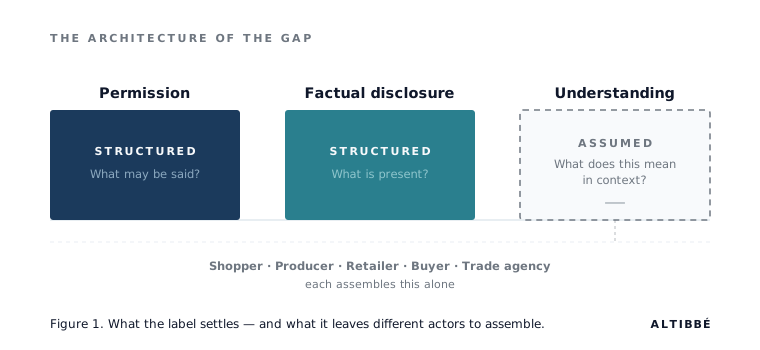
Three operations are routinely treated as one: a claim that is permitted, a fact that is disclosed, and a product that is understood.
Each layer of the system answers a different question; none answers whether the reader understands what the product is.
Usable understanding is therefore not structured but assumed — left to the reader to assemble, and stood in for by the figure of the "average consumer."
A shopper holding a package reads a health claim, glances at a panel of figures, and forms an impression of the product. Because the claim is regulated and the figures are disclosed, it is natural to conclude that the product is, in the relevant sense, understood. But three different things have happened, and only two of them were the work of the regulatory system. A statement was permitted; quantities were declared; and a person drew an inference. The first two are governed with care. The third is left to occur on its own.
Consider what the claims regime actually decides. It determines whether a statement may be made and whether it is true — permission and substantiation. Those are demanding questions, and the apparatus built to answer them is substantial. But it is an apparatus pointed at the statement, not at its reader. Nothing in the test of a claim asks whether the permitted words, once printed and read, leave the consumer with an accurate sense of what the product is. The claim is cleared to appear; what it produces in the mind of the person who reads it falls outside the frame.
The factual layer sits beside the claim and answers a different question again. Mandatory nutrient declarations disclose quantities — how much of this, how little of that — in a prescribed and reliable form. This too is structured, and it too is real. But a column of figures is not an interpretation. The numbers are accurate and, in isolation, inert; it falls to the reader to supply the knowledge that turns a quantity into a meaning. Factual disclosure discloses facts. It does not, and does not claim to, explain them.
Between the permitted claim and the declared fact lies the question neither was built to answer: what is this product, and what does it mean for the person choosing it? No part of the architecture is assigned to that question. In many systems, the law relies on a figure — the average or reasonable consumer — and asks not whether real readers understand, but whether a competent hypothetical one could be expected to. Understanding is thereby presumed by construction rather than produced by design. The standard is met when a notional reader would not be misled; whether an actual reader is left informed is not the test.
This is why the gap is structural rather than incidental. It is not that regulators overlooked understanding; it is that existing systems define understanding mainly through objective information availability and non-misleading presentation, rather than through a separate interpretive function. Permission has its authorities and its lists. Factual disclosure has its mandatory formats. Understanding remains largely with the reader, who must assemble a picture from fragments each designed for a different purpose. Even where a regime requires further context to travel with a claim, that requirement usually adds another item of information rather than evidence that the information has been understood — more to read, not necessarily more understood. More information is not the same as more understanding, and the distance between them is precisely the space no layer occupies.
A gap this consistent invites an obvious suspicion: that the systems simply failed to do something they ought to have done. The suspicion deserves to be taken seriously — and, examined closely, it does not hold.
2A · Why This Is Not a Design Failure
Section proposition. The gap between permission and understanding is the shadow of a deliberate choice, not the mark of a regulatory oversight.
What this section shows.
Claims regulation is narrow by design, because health language is precisely where deception does its work.
Asking the claims mechanism to also produce understanding would mean permitting more health language, more freely — reopening the door the regime was built to close.
The missing function is therefore not an argument for loosening claim rules; it is a question about something no existing layer was ever assigned.
The natural response to the previous section is to conclude that the regimes have simply fallen short — that a system governing health communication ought, surely, to ensure that health communication is understood. The conclusion is tempting, and it is mistaken. The narrowness that leaves understanding unaddressed is not an accident of these systems; it is the source of their value.
Health language is the part of a label most capable of harm. A statement that a food prevents, treats, or protects against illness can move a purchase, displace medical advice, and reach the anxious or the unwell. Claims regulation exists because health language is capable of deception precisely where it links ordinary products to bodily outcomes, and its method is restriction: permit only what is substantiated, in wording that cannot overstate, and prohibit the rest. The discipline that makes a permitted claim trustworthy is the same discipline that keeps it narrow.
This is why the regime cannot be asked to produce understanding on its own terms without undoing itself. Richer health communication — the contextual, explanatory language that would help a reader grasp what a product is — is also a larger surface on which to mislead. Were a regulator to widen the channel in the name of understanding, the predictable result would not be a better-informed public but a relabelling of marketing as education, with the constraints that currently hold deception in check loosened to admit it. The narrowness is load-bearing. To remove it in pursuit of understanding would be to trade a known protection for an uncertain one.
It follows that the gap identified here is not a case for relaxing claim rules; the argument runs the other way. It assumes the claim rules remain exactly as strict as they are, and asks a question they were never meant to answer: where, if not inside the claim, does the structured, non-claim information that supports understanding belong? The claims regime is right to refuse that question; the refusal is principled. But a principled refusal is still not an answer, and the question does not disappear.
This paper does not argue that food law should guarantee comprehension at the point of sale. It argues that existing systems structure permission and disclosure more clearly than they structure the link between permission, disclosure, and reader comprehension.
The gap is best understood, then, as architectural. It is not that a layer of the system performs its function badly; it is that a function exists for which no layer is responsible. Permission is held by the claims regime, factual disclosure by the labelling rules, and the connection between them remains largely with the reader. To name an absent function is not yet to specify what should fill it, and this paper does not attempt that here. What can be said at this stage is narrower and firmer: the absence is real, it is principled, and no existing layer is responsible for it.
The question, then, is whether this distinction appears only in theory, or whether it recurs across actual regimes. It recurs — consistently, and across systems that otherwise share little.
3 · Evidence & Examples
Section proposition. Across regimes that differ in law, geography, and enforcement style, the same pattern recurs: health claims are regulated for permission and substantiation, labels disclose facts, and understanding remains assumed.
What this section shows.
In five regimes that share little else, the permission layer is built with care while the understanding layer is not built at all.
The systems that look as though they might supply understanding — panels, registers, front-of-pack ratings, disclaimers — each deliver a fragment rather than an interpretation.
Where comprehension has actually been measured, claims are found to shape perception without conferring understanding, and even approved wording can read above the level of those it informs.
3.1 · The permission layer
The clearest way to see that understanding is unaddressed is to watch how differently five regimes solve the permission problem, and how identically they leave the other. Each builds an elaborate apparatus to decide what may be said about health and whether it is true. None builds anything to decide whether the result is understood.
The European Union governs by positive list: a health claim is prohibited unless its underlying effect has been scientifically assessed and the claim entered on an authorised list. The assessment is rigorous and the list is public, but its legal force lies in the regulations that establish it; the register that consolidates them is a means of finding what is permitted, not the thing that permits it. The question the system answers, exhaustively, is whether a claim is true and allowed. Whether the allowed words inform the reader is left where it began. [1][2]
The United States arrives at the same place by gradation. It sorts health claims by the weight of evidence behind them — from those backed by significant scientific agreement, through qualified claims admitted under enforcement discretion with a disclaimer. At the outer edge of that spectrum, structure/function statements may appear without pre-market approval at all, subject to a substantiation duty and, for supplements, a disclaimer. The entire spectrum is a calibration of permission: how strong the evidence must be for a given thing to be said. At no point along it is comprehension the variable being tuned. [3][4]
Japan runs two permission routes in parallel: a pre-approval system in which the authority reviews a product's effect, and a notification system in which the producer takes responsibility for the evidence and files it before sale. Both are about clearance to claim. The 2024 beni-koji incident, caused by contamination rather than by the claims regime itself, nevertheless exposed how safety reporting, product-risk context, and consumer-facing information can sit outside the ordinary claim-permission test. [7][8]
Codex goes furthest toward the missing question, which is what makes it the most useful case. Its guidelines do not stop at substantiation; they ask that a claim be accompanied by contextual information, that it aid healthful choices, and that authorities monitor its effect on behaviour — language that gestures directly at understanding. And yet the instrument remains a permission standard. The added context is more information to be disclosed; the education and monitoring are duties placed on states; comprehension is nowhere made a condition of use. The regime that comes closest still stops at the edge of the gap. [6]
Australia and New Zealand take a structural step many systems avoid: a nutrient-profile threshold that disqualifies certain foods from carrying health claims at all. This is real architecture, and it does more than police wording — it gates which products may speak. But what it gates is eligibility, not intelligibility. A food that clears the threshold and makes its permitted claim leaves its reader much as it found them. [9]
The mechanisms could hardly be more varied — a positive list, a tiered spectrum, a notification channel, a recommendation, a profile gate — yet the target never varies. Each aims, with real care, at what may be said and whether it is true.
3.2 · The adjacent systems
If understanding is not produced by the claim, perhaps it is produced by something nearby. The label carries more than claims, and a reader has more to consult than the claim alone. But each of the systems that might seem to close the gap delivers a fragment of understanding rather than the thing itself.
The nutrient declaration is the most universal of them, and the most often mistaken for a solution. It discloses quantities in a reliable, prescribed form — and there it stops. A panel of figures asks the reader to bring the knowledge that would make the figures mean something: what the numbers should be, for whom, against what diet. It is complete as disclosure and silent as interpretation.
Registers and approved-relationship lists sit further from the consumer still. They are instruments of compliance, built so that an official or a producer can determine whether a given claim is permitted. They record what may be said; they are not written for, and rarely reach, the person deciding what to buy. A system that makes permission findable has not thereby made meaning available.
Front-of-pack systems come closest to interpretation, because interpretation is their purpose, and some do real work. Mandatory warning labels and interpretive ratings do more than repeat the nutrient panel: they simplify selected information for faster judgement and can improve certain consumer evaluations, and their value should not be minimised. But the help they give is bounded. A compressed signal carries a conclusion without the reasoning, is most reliable within comparable categories and can become less informative across them, and, like any favourable cue, can contribute to a broader health impression around the product that bears it. It compresses selected nutritional attributes into a signal; it does not give a product-level account of the practices, evidence, provenance, and context behind a product. It summarises; it does not, on its own, inform. [11]
For some public-health purposes, this may be enough. A mandatory warning label that identifies a product as high in sugar, salt, or saturated fat can provide a clear risk-avoidance cue, and such cues should be credited as genuine interpretive tools. The remaining gap is narrower: these systems do not usually provide a broader product-level account of positive health-relevant attributes, production practices, evidence context, or cross-market meaning.
Disclaimers, finally, are the system's attempt to mark its own limits. A qualifying phrase signals that the evidence is weaker, or that an authority has not evaluated the statement. But a disclaimer transfers the interpretive burden rather than discharging it: it tells the reader to be cautious without telling them how, and asks an untrained reader to calibrate a claim the regulator itself declined to calibrate. [5]
Each of these is real, and each does useful work within its own remit. What none of them is — and none was built to be — is an integrated, contextual account of what a product is. Placed side by side, they remain side by side.
3.3 · The Codex baseline
Codex matters here not because it proves uniformity, but because it supplies a widely used baseline for how nutrition and health claims are categorised, substantiated, and controlled. [6] National systems may adapt that baseline in different ways, and some add interpretive front-of-pack tools or warning schemes. Even so, the Codex architecture itself remains centred on claim permission, substantiation, and non-misleading presentation; it does not assign a separate product-level interpretive function.
This bears on a natural objection — that the gap is merely fragmentation between standards, which harmonisation would resolve. Harmonising claim rules can make permission more consistent across markets, but consistency of permission is not a structured interpretive function. It would make what may be said more uniform; it would not, on its own, settle how product-level meaning is made intelligible.
3.4 · What the evidence shows
If understanding were a by-product of permission, the comprehension research would show it. It does not. It shows the opposite, and consistently: claims move the reader without informing the reader.
The clearest measure is behavioural. A systematic review and meta-analysis of health-related claims found that their presence raises the odds that a consumer chooses or buys a product — a sizeable and robust effect, largest in controlled settings where the claim can be isolated from other cues. A claim, in other words, works: it changes behaviour. The evidence is consistent with its working as a heuristic — a signal that this is the healthy choice — and a signal can move a decision without conveying anything the decider could explain afterward. The behavioural effect is well established; the comprehension it might seem to imply is not. [10]
The same literature shows that favourable cues can shape the impression a product creates. A favourable claim can raise a consumer's estimate of a product's overall healthfulness beyond what the claim itself warrants — the so-called halo effect. [12] Separately, eye-tracking work finds that fuller nutrition declarations receive only selective attention during food-selection tasks. [13] The point is not that every claim directly prevents label reading, but that the systems meant to qualify impressions are not reliably absorbed by the reader.
Nor does the tool built closest to interpretation close the distance. An interdisciplinary meta-analysis of front-of-pack labelling, drawing on a large body of studies, found that such labels help consumers identify the healthier of two options but have limited power to change what they actually choose, and that they too can generate halos around the products that carry them. A compressed signal sharpens a narrow comparison and leaves the broader understanding roughly where it was. Even the interpretive instrument compresses rather than explains. [11]
Beneath all of this sits a further constraint. Literacy and numeracy have long been identified as barriers to interpreting nutrition information, so that the same accurate, well-presented facts are understood unevenly across a population. Part of the gap, in other words, lies with the reader as much as the system, and is unlikely to be closed by wording alone. [14]
Taken together, the measures point one way. Across claims, panels, and front-of-pack signals, the instruments shape perception reliably and produce understanding unreliably. That is not a marginal shortfall to be closed with sharper wording; it is the predictable result of a system that tests permission and discloses fact, and leaves comprehension to look after itself.
3.5 · The difficulty in the instrument's own language
The gap is visible before any behavioural evidence is considered — in the approved wording itself. Consider an authorised European claim for carbohydrate-electrolyte solutions: that they "contribute to the maintenance of endurance performance during prolonged endurance exercise." The statement is scientifically exact and, by the standard that admitted it, entirely accurate. [2] It is also not written to be understood by the person holding the bottle. Its precision is genuine; its readability for ordinary readers is not; and the regime tests only the first.
This is not a failure of drafting. Wording that must survive substantiation has to be exact, and in health science exactness is rarely plain — the more rigorous the claim, the less casual its language tends to become. But it means that even a perfectly permitted, perfectly truthful claim can reach the shelf pitched above the reader it exists to inform. The gap appears here in miniature, in a single line of approved text: a statement can clear every test the system sets and still leave its reader no closer to understanding the product.
The evidence does not show that claims regulation is weak. It shows that claims regulation is doing a different job.
4 · Implications
Section proposition. If permission and understanding are different functions, then better claim control alone cannot solve the product-information problem.
The gap traced in the preceding sections is not experienced the same way by everyone who encounters it. It reads as incomprehension at the shelf, a communication constraint for the producer, information friction for the trade buyer, and a limit on evidence-based communication for the public-health practitioner. These are not four separate problems; they are the same structural absence, seen from different vantage points.
What this section shows.
Each position in the food-information chain encounters the same division of labour — what is permitted, what is disclosed, and what is assembled — from a different angle.
None of these encounters is a fault to be assigned; each follows from the architecture the evidence has described.
4.1 · For regulators
The evidence does not call the claims regime into question; if anything it confirms how well it performs its function. What it marks is the boundary of that function. A system built to decide what may be said, and tested for whether it is true, was never constructed to establish whether the result is understood — and the comprehension evidence indicates that understanding does not arrive as a by-product. The limit is not a weakness to be corrected within the claims regime; it is the edge of what a permission instrument can reach.
4.2 · For public-health professionals
The behavioural evidence shows a claim moving choice as a heuristic, ahead of and independent of any understanding it conveys. That ordering matters: a permitted, truthful claim can change what a person buys without changing what they know, and the halo around it can leave them more confident yet no better informed. Permission is not a proxy for comprehension, and the distance between the two is the space in which health communication actually operates.
4.3 · For trade agencies and institutional buyers
A lawful claim means only that a particular statement is permitted in a particular market; it does not convey how a product was made, what health-relevant practices sit behind it, or how its attributes carry across the markets it enters. For trade-facing actors, a lawful claim may function as a floor rather than a full product description: it travels as a permission, while the context that would let a distant party assess the product does not travel with it. This creates predictable information friction: the lawful claim can establish what may be said in a market, but it does not by itself explain the wider product context that a distant buyer may need to compare.
4.4 · For producers
For a producer whose practices genuinely bear on health — a growing method, a processing choice, or a provenance-linked practice that affects the product — the existing channels offer no adequate place to say so. The claim channel admits only pre-cleared, generic wording; the nutrient panel records quantities, not practices; and informal language risks straying into the territory the claims regime exists to police. The producer may therefore have information that is relevant to product understanding but difficult to express without either reducing it to a permitted claim or risking language that resembles one — not because a rule has failed, but because no channel was designed for that content.
Producers do communicate context through packaging, branding, and marketing channels. But those channels are persuasive, uneven, and legally constrained. If they say too little, the product's context is lost; if they say too much, the language can begin to resemble a health claim. The gap is therefore not an absence of producer speech, but the absence of a disciplined non-claim place for product context.
If the problem is architectural, the next question is not which claim rules to loosen, but what boundaries any response to the gap would need to respect.
5 · Toward Structural Alternatives
Section proposition. Any alternative would need to preserve the discipline of claims regulation while making room for non-claim information that supports understanding without becoming promotion.
What this section shows.
It cannot be a looser claims channel.
It cannot give advice or imply official approval.
It cannot let contextual information become promotion.
It cannot imply that acceptance in one market carries to another.
The gap examined in this paper was opened by a discipline that works. That is the starting constraint: any response must preserve what the claims regime has achieved, and cannot close the gap by reopening the territory the claims regime closed.
What follows is not a specification for a system. It is a boundary map: the evidence points only to what any response would need to avoid — loosening claim rules, giving advice, implying approval, or turning contextual information into promotion.
5.1 · Not a claim
The first requirement is the one the evidence makes plainest: whatever fills the gap cannot be another claim. A claim is permission to assert a substantiated effect; widening it to carry context would reintroduce the very deception the claims regime exists to prevent. The alternative cannot be more health language under another name — it must sit alongside the claim, not extend it.
5.2 · Not advice
Nor can it be advice. The moment product information becomes guidance about what to consume or avoid, it crosses into medical and dietary territory that is regulated elsewhere and that no producer is positioned to occupy. The requirement is to describe what a product is and how it was made — to make the product legible — not to tell the reader what to do about it.
5.3 · Not certification or approval
It cannot present itself as a verdict. A structure that issued a pass/fail judgement, or implied official endorsement, would recreate the authority the claims regime already holds and inherit the liability and gatekeeping that come with it. The requirement is the opposite: to keep contextual information distinct from any verdict, endorsement, or seal.
5.4 · Disciplined enough not to become promotion
Some discipline would still be necessary, because unrestricted narrative language can drift toward promotion. The form need not be specified here. The minimum requirement is that a reader can tell what kind of information is being presented and why it is not an authorised health claim.
5.5 · Careful across markets
Cross-market use adds a further caution. Because claim permissions are jurisdiction-bound, any supporting information would need to avoid implying that what is acceptable in one market automatically carries the same status in another.
5.6 · Closing boundary
These boundaries are deliberately restrictive, and that restrictiveness is the point. Taken together they describe something narrow: information that sits beside the claims regime without touching its function — neither a claim, nor advice, nor a seal, and disciplined enough not to drift into promotion. The gap was opened by a principled refusal to widen health language; any response that filled it by widening health language would only reproduce the problem it was meant to solve.
This paper does not propose a specific model. It outlines boundary conditions that any viable response would need to respect.
References
Regulation (EC) No 1924/2006 of the European Parliament and of the Council of 20 December 2006 on nutrition and health claims made on foods (Arts. 1, 4, 5(2), 10, 13, 14). Official Journal of the European Union, L 404, 30.12.2006, pp. 9–25.
Commission Regulation (EU) No 432/2012 of 16 May 2012 establishing a list of permitted health claims made on foods, other than those referring to the reduction of disease risk and to children's development and health. Official Journal of the European Union, L 136, 25.5.2012, pp. 1–40.
U.S. Food and Drug Administration. Label Claims for Conventional Foods and Dietary Supplements. Silver Spring, MD: FDA.
Congressional Research Service. Food and Dietary Supplement Labeling Claims. Report R48623. Washington, DC: CRS, 2025.
U.S. Food and Drug Administration. Experimental Study of Qualified Health Claims. Silver Spring, MD: FDA, 2009.
Codex Alimentarius Commission. Guidelines for Use of Nutrition and Health Claims. CAC/GL 23-1997. Rome: Joint FAO/WHO Food Standards Programme.
Consumer Affairs Agency (Japan). Foods with Function Claims: notification system and food-labelling materials. Tokyo: CAA.
Ministry of Health, Labour and Welfare (Japan) and Osaka City. Beni-koji adverse-event materials and final epidemiological report. Tokyo and Osaka: MHLW and Osaka City, 2024–2025.
Food Standards Australia New Zealand. Australia New Zealand Food Standards Code — Standard 1.2.7: Nutrition, Health and Related Claims. Canberra and Wellington: FSANZ.
Kaur A, Scarborough P, Rayner M. A systematic review and meta-analyses of the effect of health-related claims on dietary choices. Int J Behav Nutr Phys Act, 2017. doi:10.1186/s12966-017-0548-1.
Ikonen I, Sotgiu F, Aydinli A, Verlegh PWJ. Consumer effects of front-of-package nutrition labeling: an interdisciplinary meta-analysis. J Acad Mark Sci, 2020. doi:10.1007/s11747-019-00663-9.
Chandon P, Wansink B. The biasing health halos of fast-food restaurant health claims: lower calorie estimates and higher side-dish consumption intentions. Journal of Consumer Research. 2007;34(3):301–314. doi:10.1086/519499.
Graham DJ, et al. Nutrition label viewing during a food-selection task: front-of-package labels vs. Nutrition Facts labels. Journal of the Academy of Nutrition and Dietetics. 2015;115(10):1636–1646. doi:10.1016/j.jand.2015.02.019.
Malloy-Weir L, Cooper M. Health literacy, literacy, numeracy and nutrition label understanding and use: a scoping review of the literature. Journal of Human Nutrition and Dietetics. 2017;30(3):309–325. doi:10.1111/jhn.12428.