Geographic Indication systems protect the relationship between a product's name and its place of origin. They solve a specific legal problem — misrepresentation of provenance in commerce — and they solve it well. Across jurisdictions from Champagne to Darjeeling to Ceylon Cinnamon, GI frameworks have prevented fraud and preserved the collective economic value of origin names.
What GI systems were not designed to do is communicate producer-level attributes to buyers. Within any GI-protected zone, producers may operate under identical designation while varying in practices, processing detail, and measurable properties that matter to buyers. The GI record establishes the legal boundary; it does not describe what lies within it. As international buyers increasingly require producer-level documentation — for premium sourcing, ESG due diligence, and supply chain transparency — this gap has become a market constraint. This paper examines the structural origin of that gap across five jurisdictions and outlines what a complementary disclosure layer, operating alongside GI rather than replacing it, would need to satisfy.
Thesis
Origin may be protected while the knowledge behind origin remains unstated.
Position in the series
This paper examines geographic indication systems. Across the SGPIS series, the same pattern appears from different institutional angles: certification (SGPIS-GQ-01), traceability (SGPIS-GQ-02), nutrition labels (SGPIS-NL-01), trade documentation (SGPIS-TC-01), and India’s product-information stack (SGPIS-SY-01) each perform defined functions, but none consistently carries enough information for the product to remain understood across settings.
Citation
APA
Ahmed, S. (2026). Geographic Indication Without Disclosure Depth. Structural Gaps in Product Information Systems, SGPIS-PI-01. Altibbé Research. https://doi.org/10.5281/zenodo.20375819
Institutional
Ahmed, S. (2026). Geographic Indication Without Disclosure Depth. Structural Gaps in Product Information Systems, SGPIS-PI-01, v1. Altibbé Research. https://doi.org/10.5281/zenodo.20375819
SGPIS-PI-01
Geographic Indication Without Disclosure Depth: The Structural Limits of AOC, AOP, and GI Systems
Structural Gaps in Product Information Systems — Producer Identity Series Altibbe Research | April 2026
EXECUTIVE SUMMARY
Geographic Indication systems protect the relationship between a product's name and its place of origin. They solve a specific legal problem — misrepresentation of provenance in commerce — and they solve it well. Across jurisdictions from Champagne to Darjeeling to Ceylon Cinnamon, GI frameworks have successfully prevented fraud and preserved the collective economic value of origin names.
What GI systems were not designed to do is communicate producer-level attributes to buyers. Within any GI-protected zone, producers may operate under identical designation while still varying in practices, process detail, and other attributes that matter to buyers. The GI record establishes the legal boundary; it does not describe what lies within it.
As international buyers increasingly require producer-level documentation — for premium sourcing, ESG due diligence, and supply chain transparency — this gap has become a market constraint. GI systems, as currently designed, do not provide a standardised, reusable producer-level disclosure layer. Where that need is instead met through fragmented adjacent mechanisms, the resulting burden falls unevenly and is not cumulatively resolved across buyers.
THE PROMISE
Geographic Indication systems emerged from a straightforward problem: the economic value embedded in a product's origin — built over generations by producers in a specific place — was being appropriated by producers elsewhere. Champagne from regions outside the Champagne appellation. Parmigiano-style cheeses sold under names indistinguishable from the Italian original. Teas labelled Darjeeling that contained no leaf from the Darjeeling district.
The response was a framework of legal protection anchored to geography. Under the Agreement on Trade-Related Aspects of Intellectual Property Rights (TRIPS), Articles 22–24 established the foundational international architecture: a GI identifies goods as originating in a territory where a given quality, reputation, or other characteristic is essentially attributable to its geographical origin.[1] Member countries built national and regional frameworks on this foundation: the EU's Protected Designation of Origin (PDO) and Protected Geographical Indication (PGI); France's Appellation d'Origine Contrôlée (AOC) and Appellation d'Origine Protégée (AOP); India's Geographical Indications of Goods (Registration and Protection) Act, 1999; Japan's GI protection framework under the Ministry of Agriculture, Forestry and Fisheries, established in 2015.
The achievements of this architecture are real. The EU's GI system alone covers approximately 3,600 products and generates annual sales exceeding €77 billion.[2] A 2021 European Commission study found GI-protected products command an average premium over comparable unprotected products that is economically significant.[3] In India, the GI Registry has issued over 500 registrations across tea, spices, handicrafts, and agricultural goods.[4] That protection is real and has proven effective — it represents the system working as designed, giving collective producer groups a mechanism to capture geographic distinctiveness as economic value.
THE STRUCTURAL PROBLEM
GI systems establish a boundary. They were not designed to describe what lies within it.
The information exists at the farm. It does not travel. Within GI-protected corridors specifically, this separation is structural: the GI record was designed to hold collective origin, not individual producer attributes.
This distinction matters because of how the information architecture is constructed. A GI registration record contains, in most jurisdictions: the designated geographic area, the product specifications that define minimum acceptable standards for producers operating within that area, the rules governing use of the designation, and the legal terms under which protection is granted and enforced. It does not contain individual producer attributes — who the producers are, how their specific practices differ from others within the zone, what measurable properties their products carry, or how their heritage contextualises what is produced.
Within a GI zone, variation among producers can be substantial. In the Darjeeling district, where approximately 87 registered tea gardens operate under the same GI designation, the GI record does not capture estate-level variation in practices and characteristics in a standardised, buyer-readable form. A buyer seeking to understand what distinguishes one estate's product from another's — processing method, elevation, seasonal characteristics — must assemble that information outside the GI system entirely, through direct correspondence, broker relationships, or accumulated trade knowledge.
This is a structural feature of how GI systems were designed, not a gap in implementation. The collective nature of GI protection is precisely what gives it legal and economic force — a design principle the major GI jurisdictions have consistently maintained, as the regulatory record in Section 2A documents. Buyers in premium and due-diligence-intensive markets increasingly require origin specificity, production practices, health-relevant properties, and heritage context — but no standardised format exists within GI architecture for producers to communicate this consistently. The GI designation protects a shared name. It does not carry the full attribute set buyers may require from the producers behind it.
The consequence is that individual producer attributes sit outside the documentation system that gives a product its protected status. The GI layer is legally robust and internationally recognised. The producer attribute layer is, in most cases, absent from any formal record.
2A. WHY THIS IS NOT A DESIGN FAILURE
The limitations described above are not the result of inadequate regulation or poor implementation. They are an inherent consequence of what GI systems were built to solve.
The Lisbon Agreement of 1958 — the first multilateral instrument for GI protection — was a response to commercial fraud, not a documentation initiative. Its architects were addressing a problem of misattribution: producers in one place appropriating the name and reputation of producers in another. The instrument they designed was precisely calibrated to that problem. A framework designed for legal boundary protection was not, in its founding design logic, intended to operate as a producer-level disclosure system. The two tasks require different information architectures.
In many GI frameworks, the producing body intentionally organises around collective specification rather than producer-level differentiation. Parmigiano Reggiano's Consorzio maintains standards at the collective level not merely because individual documentation is difficult, but because the collective standard is itself the product. The system is working as designed when it does not differentiate among the producers within its zone.
Where Paper 2 of this series examined certification systems and their scope boundaries, and Paper 3 examined trade documentation and the gap between naming and describing a product,[5][6] this paper examines a third distinct layer: GI systems, which protect the legal identity of a collective origin while leaving the attributes of individual producers within that origin undocumented. Each system was built for the problem it was given.
The observable regulatory record reinforces this. The European Commission's GI reform regulation, effective December 2023, substantially strengthened enforcement and extended GI protection to non-agricultural products.[7] The reform's scope remained bounded to origin protection and enforcement — expanding GI's legal reach without extending its information depth. Across all major GI reform activity in the jurisdictions examined in this paper, the pattern is consistent: GI's information architecture has been designed and maintained around collective origin, not individual producer attributes.
EVIDENCE AND EXAMPLES
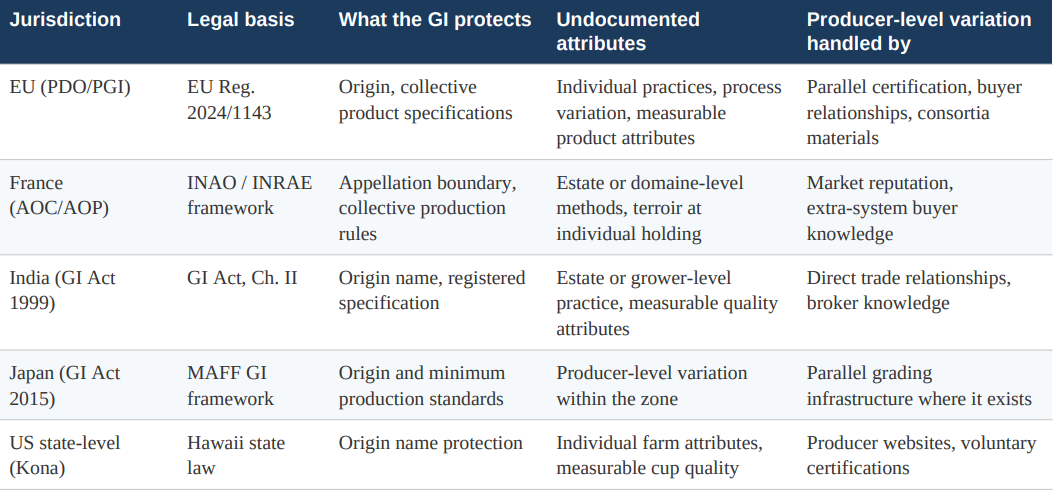
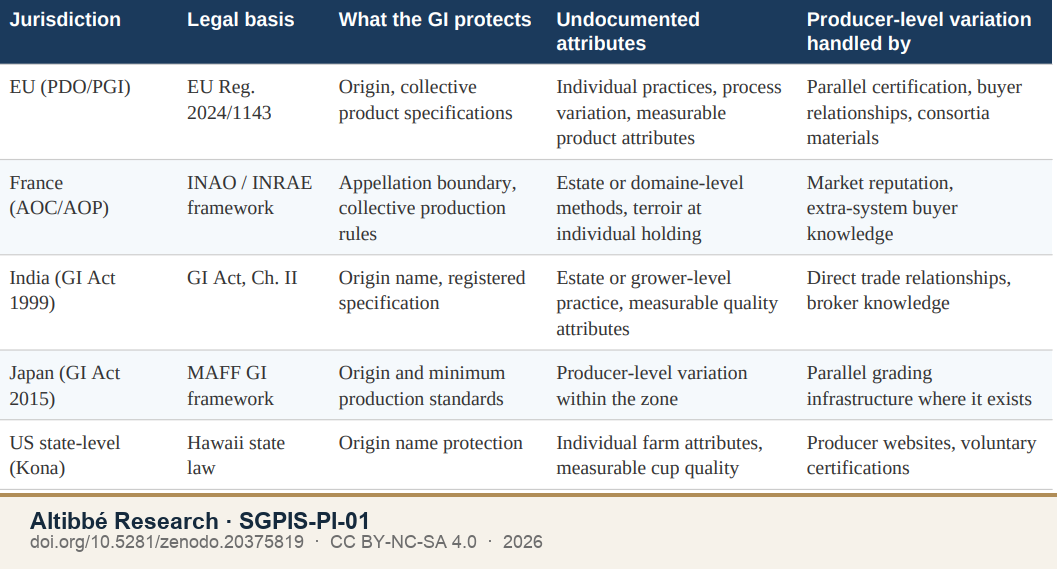
The following table summarises how five GI frameworks define protection scope and what they leave structurally undocumented at the producer level.
Sri Lanka registered Ceylon Cinnamon as a GI in 2007, with subsequent protections established in EU trade frameworks.[8] The designation is commercially significant: it creates the legal basis for distinguishing Cinnamomum verum — the species native to Sri Lanka — from cassia species (C. cassia, C. aromaticum) widely marketed under the generic name "cinnamon" in global commodity trade.
The chemical distinction between these species is well documented. C. verum contains substantially lower levels of coumarin than cassia varieties. European Food Safety Authority opinions on coumarin have established tolerable daily intake guidance that, in practical terms, creates regulatory differentiation between the two species for buyers in certain product categories.[9] The GI designation, by distinguishing C. verum from cassia, provides that information at the species level.
What the GI designation does not provide is documentation of the full attribute set buyers may require beyond species confirmation. EU market entry guidance for cinnamon identifies buyer requirements — including coumarin limits, sulphur dioxide thresholds, and lead content specifications — as documentation that producers must supply through channels separate from GI status.[10] Tens of thousands of smallholder families in Sri Lanka produce cinnamon under the same designation. The GI confirms species and origin for the collective. It does not document individual producers' processing methods, post-harvest handling conditions, or measurable properties that vary at the producer level and matter to buyers operating under regulatory or procurement specifications.
Darjeeling Tea, India
Darjeeling became India's first GI registered product in 2004–05, administered by the Tea Board of India.[11] The designation has been enforced internationally against misrepresentation — historically, global sales of product labelled "Darjeeling" significantly exceeded actual Darjeeling district output.[12] The GI registration has materially addressed this.
The producer documentation gap manifests through absence rather than error. The approximately 87 registered tea gardens and associated small growers carry identical GI designation. Seasonal and estate-level characteristics that constitute Darjeeling's premium differentiation in specialty markets — and that buyers in those markets actively seek — exist in trade knowledge but not in standardised, transferable documentation. A new buyer entering the market, or an institutional procurement system conducting due diligence, cannot retrieve estate-level information from the GI record. It must be assembled from outside the formal system.
Champagne, France
The Champagne AOC is among the most enforced and commercially valuable GI protections globally, representing approximately €5.5 billion in annual export value.[13] Within the protected zone, approximately 15,500 producers operate — from small family estates to large negociant houses sourcing grapes across the appellation.
Both categories carry identical geographic documentation. The market has developed an informal parallel mechanism: a producer code (RM — récoltant-manipulant) visible on the label indicates grower-producer status, distinguishing estate-produced champagne from negociant-assembled product. This informal code is not part of the AOC documentation architecture. It is buyer knowledge that has accumulated and circulated outside the formal system because the formal system does not distinguish among producers within the appellation. A globally successful designation still relies on parallel, extra-system knowledge to make meaningful differences within the protected zone legible to buyers.
As Paper 3 of this series established for trade documentation generally, buyer-side workarounds of this kind are per-buyer, non-standardised, and non-cumulative.[6] The same pattern applies within GI corridors: informal mechanisms supply producer-level attributes in some channels, but each new buyer relationship requires the documentation burden to be rebuilt from the beginning. The information does not carry forward.
Kona Coffee, United States
Kona Coffee carries geographic protection under Hawaiian state law — a jurisdiction-specific form of origin designation operating outside the TRIPS/Lisbon framework. Hawaiian law permits products marketed as "Kona blend" to contain as little as 10% Kona-grown coffee, with ongoing legislative debate as of 2024–25 over proposals to raise this threshold.[14] This case illustrates a related structural point: name protection alone does not ensure that buyer-facing documentation carries the attributes that distinguish genuine origin product from other commercial forms within the same designated category.
Japan — GI and Parallel Grading
Japan's GI protection system now covers over 120 registered agricultural and food products.[15] Some Japanese GI-protected products — notably wagyu — also operate within a parallel grading infrastructure (the Beef Marbling Standard) that creates producer-level differentiation through a separate documentation track. The GI establishes origin; the grading system carries the attribute layer that enables buyer interpretation within that origin.
This interaction is structurally informative: where a parallel attribute documentation infrastructure exists independently, it supplements GI without conflicting with it. Where it does not exist, the GI designation stands alone — carrying origin protection without the attribute layer that differentiates producers within the boundary. The gap is present wherever origin protection operates without a complementary disclosure architecture.
IMPLICATIONS
For trade policy and export promotion
The convergence of premium buyer requirements, retailer sustainability policies, and ESG due diligence frameworks is increasing the documentary burden on GI-protected producers at precisely the point where their formal documentation is structurally weakest. A Darjeeling estate navigating a European specialty retailer's supplier questionnaire, or a Sri Lankan cinnamon cooperative seeking to supply a buyer requiring health-attribute documentation, must assemble producer-level information through means entirely outside the GI system. There is no standard format, no recognised channel, and no reusable documentation asset.
For export promotion agencies, this creates a specific operational constraint. The agency may support origin recognition — confirming GI status, assisting with registration, enforcing against misuse — but not the reusable producer-level documentation increasingly required by premium and due-diligence-intensive markets. GI success in origin protection does not translate automatically into buyer intelligibility for the full range of attributes those markets now require.
For buyers and procurement systems
Institutional procurement operating under ESG or supply chain transparency requirements cannot treat GI status as sufficient for producer-level due diligence. A GI designation answers the origin question. It does not answer the practice question, the health-attribute question, or the heritage question.
Where buyers require these answers, they generate parallel documentation requests through informal channels — broker relationships, buyer questionnaires, direct producer correspondence. These channels function in established trade relationships. Their structural limitation is not that they fail, but that they are non-reusable: each new buyer relationship requires the documentation burden to be rebuilt from the beginning, at the producer's cost. The producer who has supplied a comprehensive attribute dossier to one buyer derives no documentation benefit when approaching the next. Across a population of producers, this systematically advantages larger and better-resourced actors who can absorb repeated documentation costs over multiple buyer relationships, and disadvantages smaller producers for whom each new relationship represents a disproportionate investment.[16][17] Research across agri-food value chains documents that tighter quality and documentation requirements add to external transaction costs in precisely this asymmetric pattern.[18]
The market has therefore not resolved this problem — it has distributed it unevenly. The question of who bears the documentation burden is not neutral.
For producers within GI zones
The collective protection that GI systems provide is real and valuable. The structural constraint is that a producer who has invested in demonstrably superior practices, measurable product quality, or greater heritage depth has no formal documentation channel to make that investment legible to buyers outside existing trade relationships. The gap is not in the product. It is in the information architecture that surrounds it.
TOWARD STRUCTURAL ALTERNATIVES
The structural gap described in this paper — between origin protection and producer attribute disclosure — would require a distinct information layer to address. This is not a proposal to reform GI systems; those systems are working correctly within their designed scope. It is a recognition that a complementary architecture, operating alongside GI rather than replacing it, would need to satisfy a different set of requirements.
Any such architecture would need to satisfy the following structural conditions.
First, it would need to operate at the individual producer level, not the collective level that GI designates. The GI designation would remain the authoritative legal instrument for origin protection; a producer-level layer would describe attributes of specific producers within the designated area without contesting or duplicating that protection.
Second, it would need to capture attributes that lie outside GI scope: cultivation and processing practices, measurable product properties relevant to buyer decision-making, and heritage information that contextualises how and why a product is produced in a particular way.
Third, it would need to be structured in formats interpretable by the range of buyer systems that require this information — from specialty importers to institutional procurement platforms to ESG reporting frameworks. Unstructured narrative is insufficient for buyer systems handling volume across multiple producers, markets, and jurisdictions.
Fourth, it would need to preserve the integrity of the GI designation. Producer-level disclosure should supplement, not contest, the collective legal protection that GI provides.
Fifth, any such architecture would need to maintain producer-origin attribution as a foundational design principle. The paper's evidence shows that where producer attributes travel through informal channels — broker relationships, per-buyer questionnaires, accumulated trade knowledge — they arrive at buyers filtered through intermediaries rather than originating from producers directly. An architecture that reproduces this intermediary positioning would recreate the non-reusability the gap itself creates. The governance arrangements through which producer-origin attribution is maintained remain a question for institutional design.
This paper does not propose a specific model. It outlines structural requirements that any viable alternative would need to satisfy. What the evidence across jurisdictions confirms is that GI systems, as currently designed, do not satisfy these requirements — and that the gap between origin protection and producer attribute disclosure reflects the bounded scope of the current architecture, not an incidental oversight.
REFERENCES
World Trade Organization. Agreement on Trade-Related Aspects of Intellectual Property Rights (TRIPS), Articles 22–24. Geneva: WTO, 1994.
European Commission. Geographical Indications: Agri-Food Products. Brussels: DG AGRI, 2021.
European Commission. Study on Economic Value of EU Quality Schemes, Geographical Indications (GIs) and Traditional Specialities Guaranteed (TSGs). Brussels: Publications Office of the European Union, 2021.
Government of India, Office of the Controller General of Patents, Designs and Trade Marks. Geographical Indications Registry: Statistical Report 2023–24. Chennai: CGPDTM, 2024.
Altibbe Research. Certification as Minimum Threshold: Why Quality Systems Establish Acceptability, Not Differentiation. SGPIS-GQ-01. California: Altibbe Inc., 2026.
Altibbe Research. The Information Gap in Food Trade Corridors: When Products Move Faster Than Their Documentation. SGPIS-TC-01. California: Altibbe Inc., 2026.
Regulation (EU) 2024/1143 of the European Parliament and of the Council on geographical indications for wine, spirit drinks and agricultural products. Official Journal of the European Union, L 1143, 2024.
Sri Lanka Standards Institution. GI Registration: Ceylon Cinnamon. Registration Record. Colombo: SLSI, 2007.
European Food Safety Authority. Scientific Opinion on coumarin in flavourings and other food ingredients with flavouring properties. EFSA Journal 2008;793. Parma: EFSA, 2008.
CBI — Centre for the Promotion of Imports from Developing Countries. Entering the European Market for Cinnamon. The Hague: CBI, 2024.
Tea Board of India. Darjeeling GI Registration. Application No. 1. Kolkata: Tea Board, 2004.
Tea Board of India. Darjeeling Tea: Production and Trade Statistics 2022–23. Kolkata: Tea Board, 2023.
Comité Champagne. Champagne Panorama 2023: Economic and Export Data. Épernay: CIVC, 2024.
Hawaii Department of Agriculture. Kona Coffee Regulations and Blending Standards Review. Honolulu: HDOA, 2021.
Ministry of Agriculture, Forestry and Fisheries, Japan. List of Registered GIs under the GI Act. Tokyo: MAFF, 2024.
Maertens, M. and Swinnen, J.F.M. "Trade, Standards, and Poverty: Evidence from Senegal." World Development 2009;37(1):161–178.
UNCTAD. Key Statistics and Trends in Trade Policy 2024. Geneva: UNCTAD, 2024.
Barrett, C.B., Reardon, T., Swinnen, J. and Zilberman, D. "Agri-food Value Chain Revolutions in Low- and Middle-Income Countries." Journal of Economic Literature 2022;60(4):1316–1377.